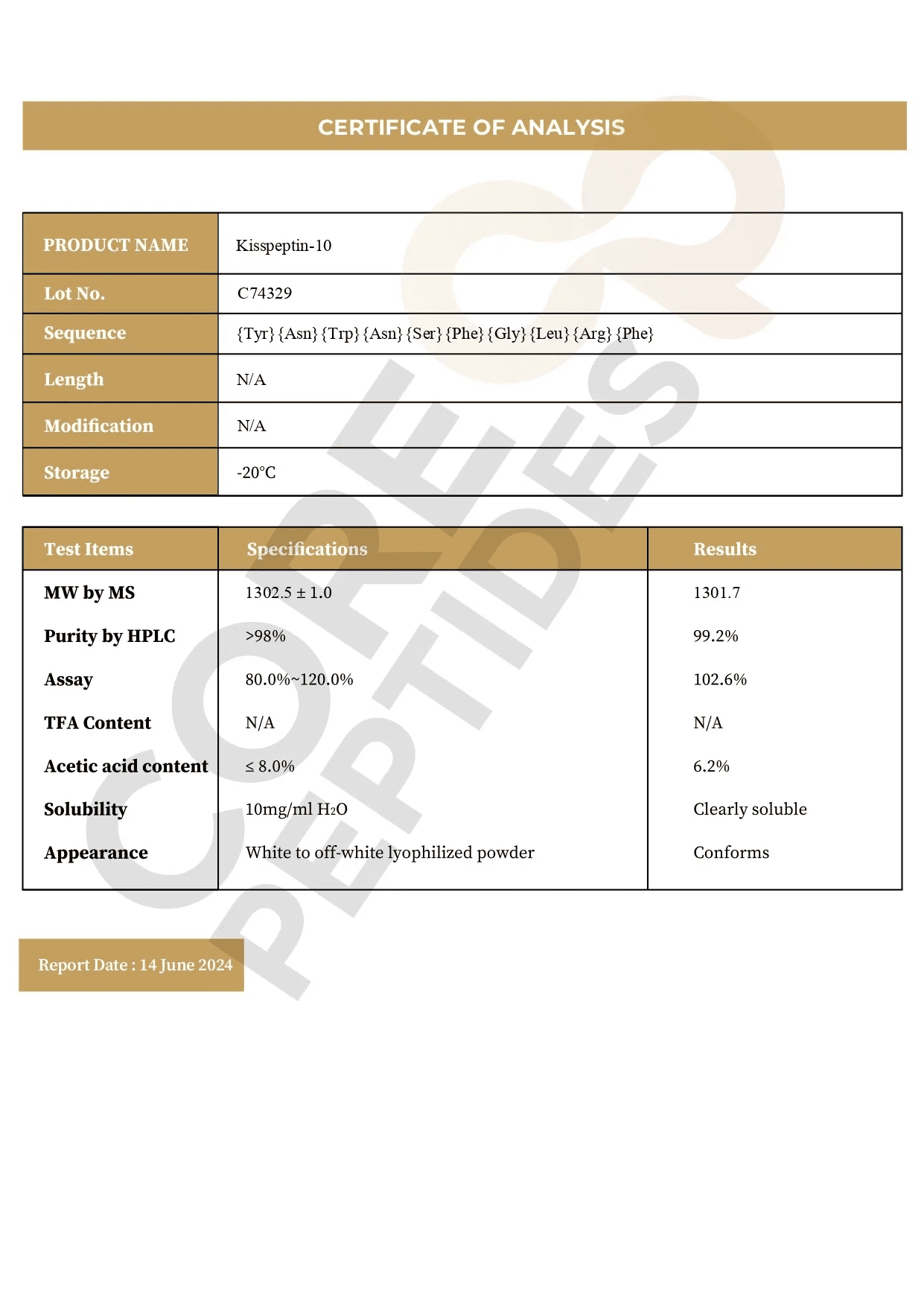
Certificate Of Analysis
Use Code: PEP-10 — Enjoy 10% Off your purchase at checkout. Limited-time offer! Dismiss

$63.00
Size: 10mg
Contents: Kisspeptin-10 (10mg)
Form: Lyophilized powder
Purity: >99%
SKU: P-KISSPEPT-10
FREE Shipping on $200+ orders
| Quantity | Discount | Price |
|---|---|---|
| 5 – 8 | 5% | $59.85 |
| 9 + | 10% | $56.70 |
Kisspeptin-10 is a naturally occurring neuropeptide derived from the KISS1 gene, which was first identified as a metastasis suppressor gene associated with the inhibition of melanoma and breast carcinoma spread. The peptide originates from the enzymatic cleavage of a 145-amino acid precursor protein, resulting in smaller biologically active fragments — most notably Kisspeptin-10 (also known as Kisspeptin 45–54).
This peptide functions primarily as a ligand for the G-protein coupled receptor 54 (GPR54), also known as the KISS1 receptor (KISS1R). The Kisspeptin–GPR54 system has been the focus of extensive research due to its possible role in reproductive regulation, hormonal signaling, and neuroprotective activity.
Molecular Formula: C₆₃H₈₃N₁₇O₁₄
Molecular Weight: 1302.4 g/mol
Synonyms: Kisspeptin 45–54, KISS1-derived peptide
Kisspeptin-10 is believed to play a pivotal role in the activation of the hypothalamic–pituitary–gonadal (HPG) axis. It may bind to GPR54 receptors in the hypothalamus, stimulating the secretion of gonadotropin-releasing hormone (GnRH), which in turn may trigger the pituitary to release luteinizing hormone (LH) and follicle-stimulating hormone (FSH).
Research suggests that Kisspeptin-10 may act as a regulatory neuropeptide in the onset of puberty and the maintenance of reproductive hormone balance.
Experimental studies in animal models of hypogonadotropic hypogonadism (HH) and polycystic ovarian syndrome (PCOS) have indicated that dysfunction in the KISS1/GPR54 signaling pathway may impair normal gonadotropin release. In such models, exogenous administration of Kisspeptin-10 appeared to stimulate GnRH and LH release, suggesting possible value as a research model for reproductive endocrinology.
In one study examining delayed sexual development, Kisspeptin-10 administration resulted in increased LH secretion in nearly half of the experimental models, demonstrating potential stimulatory effects on the reproductive axis. These findings support the hypothesis that Kisspeptin-10 may play a regulatory role in gonadal hormone release and pubertal maturation.
Neuroimaging-based studies have proposed that Kisspeptin-10 may influence limbic brain activity, potentially affecting emotional responses to sexual and social stimuli. The peptide’s neuroendocrine interactions suggest a link between reproductive hormones and emotional regulation.
Kisspeptin-10 appears to be distributed throughout brain regions including the hippocampus, hypothalamus, and cerebellum. Animal studies suggest that Kisspeptin-10 may modulate food intake, possibly by influencing neuropeptide Y (NPY) and brain-derived neurotrophic factor (BDNF) gene expression in hypothalamic cells.
Data indicate that Kisspeptin-10 may temporarily reduce meal frequency and duration, suggesting a role in appetite and metabolic research.
Research involving models with impaired Kisspeptin signaling has indicated sex-specific metabolic alterations. Female models with defective KISS1 systems displayed obesity, decreased locomotor activity, and glucose intolerance, while male models appeared unaffected. These findings may highlight a sex-dependent metabolic influence of Kisspeptin-10.
Recent investigations suggest that Kisspeptin-10 may exhibit neuroprotective properties, possibly by interacting with amyloid-beta (Aβ) and alpha-synuclein (α-syn)—proteins implicated in neurodegenerative diseases.
In vitro studies have proposed that Kisspeptin-10 might reduce Aβ and α-syn-induced toxicity in cholinergic neurons, potentially lowering apoptosis and mitochondrial damage. Interestingly, this protective mechanism may occur independently of GPR54 receptor activation, suggesting a receptor-independent neuroprotective pathway.
Kisspeptin-10 peptide represents an intriguing target of scientific research, particularly in the fields of reproductive endocrinology, neurobiology, and metabolic regulation. Its potential actions on the GnRH axis, energy metabolism, and neuronal protection make it a subject of growing interest in modern biomedical studies.
Kisspeptin-10 is provided for research and laboratory use only. It is not approved for human consumption, medical, or veterinary use. Please ensure proper handling and adherence to applicable research regulations.
U.S. National Library of Medicine. Hypogonadotropic Hypogonadism.
NCBI Gene ID: 3814 – KISS1 KiSS-1 Metastasis Suppressor (Homo sapiens).
Tena-Sempere M. et al. Endocrinology, 2004.
Navarro V.M. et al. Proc Natl Acad Sci USA, 2005.
d’Anglemont de Tassigny X. et al. Front Neuroendocrinol, 2010.
Kotani M. et al. J Biol Chem, 2001.
Roa J. & Tena-Sempere M. Endocrinology, 2014.
Jayasena C.N. et al. J Clin Endocrinol Metab, 2014.
Thompson E.L. et al. Neuroscience, 2006.
Plant T.M. Endocrinology, 2015.
Ni Y. et al. Neuroscience Letters, 2012.
Kimura F. et al. Brain Research, 2011.
Ramaswamy S. et al. Neuroendocrinology, 2007.
Comninos A.N. et al. J Clin Invest, 2017.
Jayasena C.N. et al. J Clin Endocrinol Metab, 2009.
Hata S. et al. Biochem Biophys Res Commun, 2016.
Park S.J. et al. Neurochem Int, 2019.
Kim J.Y. et al. Mol Neurobiol, 2020.