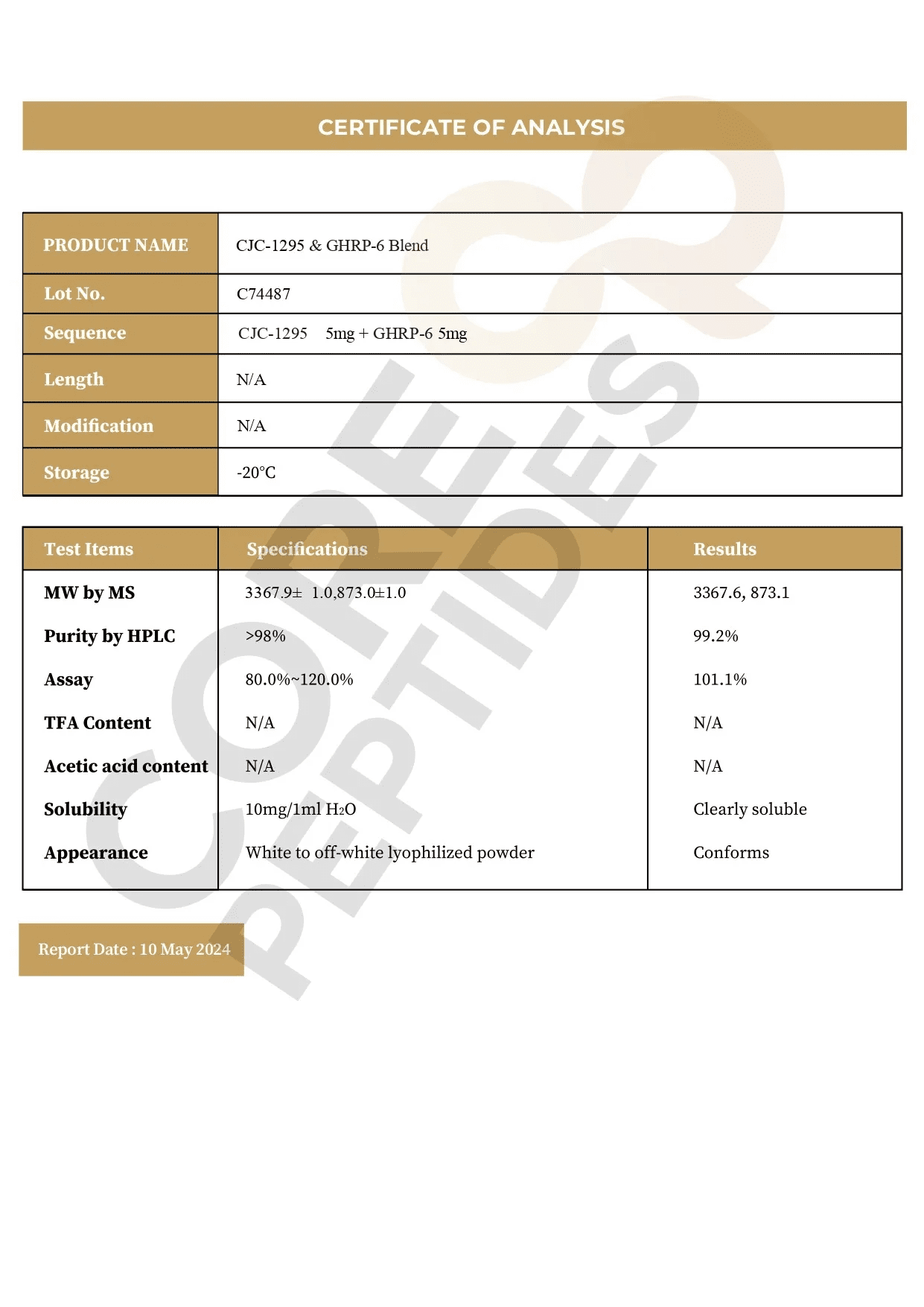
Certificate Of Analysis
Use Code: PEP-10 — Enjoy 10% Off your purchase at checkout. Limited-time offer! Dismiss

$69.00
Size: 10mg
Contents: CJC-1295 NO DAC (5mg) & GHRP-6 (5mg)
Form: Lyophilized powder
Purity: >99%
SKU: P-CJCGHR6-10
FREE Shipping on $200+ orders
| Quantity | Discount | Price |
|---|---|---|
| 5 – 8 | 5% | $65.55 |
| 9 + | 10% | $62.10 |
Overview
The combination of CJC-1295 and GHRP-6 represents a synergistic peptide blend designed to enhance endogenous growth hormone (GH) secretion. CJC-1295 is a synthetic analog of growth hormone-releasing hormone (GHRH), while GHRP-6 is a synthetic hexapeptide analog of ghrelin, classified as a growth hormone secretagogue (GHS). When administered together, these peptides are theorized to act on distinct molecular pathways, stimulating GH release more effectively than either peptide alone. This blend has been studied for potential benefits in muscle repair, tissue regeneration, neuroprotection, gastrointestinal support, and cardiac repair.
Peptide Composition and Chemistry
| Peptide | Amino Acids | Molecular Formula | Molecular Weight | Other Names |
|---|---|---|---|---|
| CJC-1295 | 29 (tetrasubstituted GRF 1-29) | C152H252N44O42 | 3367.9 g/mol | CJC-1295 DAC, CJC-1295 NO DAC |
| GHRP-6 | 6 (hexapeptide) | C46H56N12O6 | 873.0 g/mol | Growth hormone-releasing hexapeptide |
Structural Features of CJC-1295:
Four amino acid substitutions (positions 2, 8, 15, 27) to enhance stability against enzymatic degradation and improve binding to GHRH receptors.
2nd position: L-alanine → D-alanine (resistance to molecular breakdown)
8th position: Asparagine → Glutamine (reduces amide hydrolysis)
15th position: Glycine → Alanine (enhances bioactivity)
27th position: Methionine → Leucine (prevents oxidation)
DAC component (when included) binds plasma proteins, extending half-life to ~8 days while maintaining receptor affinity.
Structural Features of GHRP-6:
Hexapeptide analog of ghrelin, though structurally unrelated, acts via GHS-R1a receptors in somatotroph cells.
Opioid-like backbone without opioid activity, promoting GH release and modulating somatostatin inhibition.
Mechanism of Action
CJC-1295
Binds GHRH receptors on anterior pituitary somatotrophs.
Activates G-proteins, generating secondary messengers (cAMP, IP3) that activate protein kinases.
Phosphorylated transcription factors regulate GH gene expression, increasing GH synthesis and secretion.
GHRP-6
Binds GHS-R1a receptors, mimicking ghrelin activity.
Antagonizes somatostatin, reducing GH inhibition.
Activates intracellular Ca²⁺ release and PKC pathways, promoting GH exocytosis.
Synergistic Action
CJC-1295 sustains GH release over prolonged periods, while GHRP-6 induces rapid, early-phase GH secretion.
The blend maximizes GH pulsatility, leading to enhanced IGF-1 production, tissue repair, and anabolic effects.
Pharmacokinetics
| Peptide | Half-Life | Duration of Action |
|---|---|---|
| CJC-1295 (No DAC) | ~30 minutes | Moderate GH elevation; single-dose effect 1–3 days |
| CJC-1295 (DAC) | ~6–8 days | Sustained GH elevation; prolonged IGF-1 effect |
| GHRP-6 | ~15–60 minutes | Short-acting; rapid GH stimulation |
Physiological Effects
Muscle & Tissue Repair: Stimulates fibroblast and myocyte proliferation; supports ligament and tendon recovery.
Fat Metabolism: GH-mediated lipolysis may reduce adipose tissue.
Bone Health: IGF-1 enhances osteoblast activity and bone density.
Neuroprotection: Increases IGF-1 mRNA in hypothalamus, hippocampus, and cerebellum; activates Akt and Bcl-2 pathways to reduce apoptosis.
Gastrointestinal Function: Improves gastric emptying and intestinal transit, potentially countering diabetes-induced GI dysmotility.
Cardiac Repair: Promotes cardiac tissue regeneration, improves ejection fraction, and reduces infarct size post-myocardial injury.
Research Findings
Clinical trials in adults show 7.5- to 10-fold increases in GH levels after CJC-1295 or CJC-1295/GHRP-6 administration.
Pediatric studies indicate GHRP-6 alone or with arginine elevates GH regardless of co-factors.
In hypothyroid patients, the peptide blend elicited higher GH responses than either peptide alone, suggesting somatostatin antagonism by GHRP-6 enhances GHRH activity.
Animal studies suggest improved cellular migration, tissue repair, and protective effects on gut epithelium and immune-related tissues.
Applications
Research in GH deficiency, hypothyroidism, aging, sarcopenia, and tissue regeneration.
Investigating synergistic GH stimulation for muscle hypertrophy, fat reduction, bone health, and neuroprotection.
Laboratory studies on GHS-R1a and GHRH receptor signaling, somatotroph proliferation, and IGF-1 modulation.
Important Note: This peptide blend is intended for research and laboratory purposes only and is not approved for therapeutic use in humans. Handle according to proper laboratory protocols.
References
NCBI PubChem CID 9919153, Growth Hormone-Releasing Hexapeptide.
NCBI PubChem CID 91976842, CJC1295 Without DAC.
Berlanga-Acosta J, et al. Clinical Medicine Insights: Cardiology. 2017;11:1179546817694558. doi:10.1177/1179546817694558
Ionescu M, Frohman LA. J Clin Endocrinol Metab. 2006;91(12):4792–4797. doi:10.1210/jc.2006-1702
Madalina Ionescu et al., Clinical Study on Long-Acting GHRH Preparations.
Pediatric GHRP-6 Study, PubMed
Pimentel-Filho FR, et al., 1997, GH and Hypothyroidism Study
Experimental Animal Models – Tissue Repair Study
Zheng Q, et al., Diabetes GI Motility Study
Schally AV, et al., Cardiac Repair Studies
Neuroprotection & IGF-1 System Researc