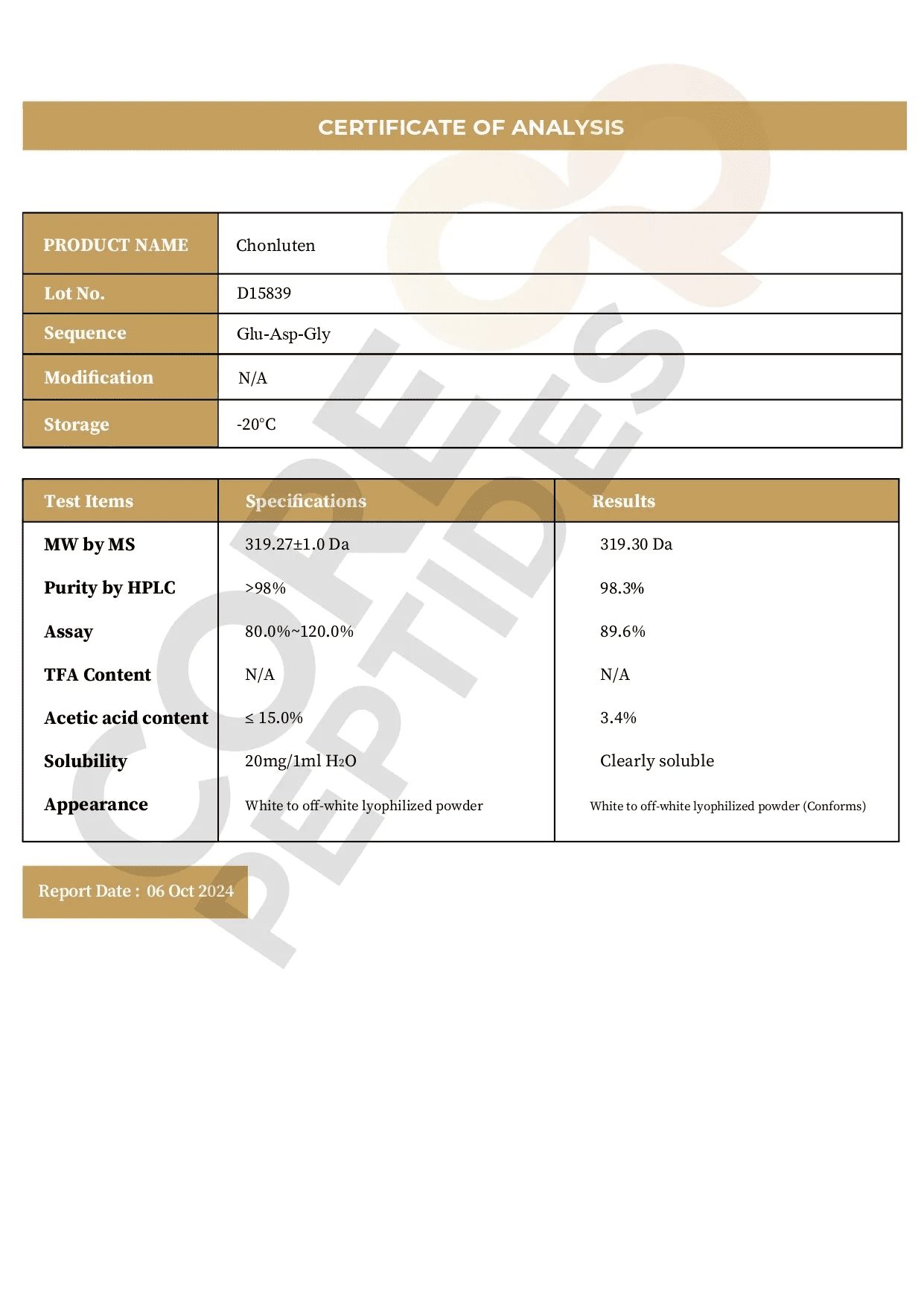
Certificate Of Analysis
Use Code: PEP-10 — Enjoy 10% Off your purchase at checkout. Limited-time offer! Dismiss

$51.00
Size: 20mg
Contents: Chonluten (20mg)
Form: Lyophilized powder
Purity: >99%
SKU: P-Chonluten
FREE Shipping on $200+ orders
| Quantity | Discount | Price |
|---|---|---|
| 5 – 8 | 5% | $48.45 |
| 9 + | 10% | $45.90 |
Overview
Chonluten, also known as EDG tripeptide or T-34, is a synthetic tripeptide composed of glutamic acid, aspartic acid, and glycine (Glu-Asp-Gly). It is hypothesized to regulate key physiological processes in the respiratory and gastrointestinal systems, primarily through anti-inflammatory, proliferative, and tissue-protective mechanisms. Chonluten may also influence anabolic and catabolic balance, potentially supporting tissue repair, stem cell longevity, and cellular resilience against stressors such as oxidative damage or hypoxia.
Chonluten has been investigated for its organ-specific activity, with primary effects in the lungs, bronchial mucosa, and potentially extending to the gastrointestinal tract, aiding epithelial tissue repair and functional normalization.
Chemical Composition and Structure
Molecular Formula: C11H17N3O8
Molecular Weight: 319.27 g/mol
Structure: (4S)-4-amino-5-[[(2S)-3-carboxy-1-(carboxymethyl amino)-1-oxopropan-2-yl]amino]-5-oxopentanoic acid
Other Names: Glu-Asp-Gly, Glutamyl-Aspartyl-Glycine, H-Glu-asp-gly-OH, T-34 tripeptide
Mechanisms of Action
Respiratory System and Inflammation Modulation
Chonluten may normalize bronchial mucosa function, reducing inflammation and regulating mucus secretion.
Potentially decreases apoptosis and enhances proliferation of bronchial epithelial cells.
Suggested to modulate STAT signaling pathways, including:
STAT1 activation in macrophages, enhancing immune regulation.
STAT3 inhibition, reducing IL-6 gene expression and inflammatory response.
Reduces inflammatory mediators such as TNF, IL-6, and IL-17 in activated immune cells.
May inhibit adhesion of immune cells to endothelial surfaces, potentially regulating immune trafficking and tissue inflammation.
Gastrointestinal Tract Support
May protect gastric and intestinal mucosa, reducing oxidative stress and tissue inflammation.
Potentially regulates expression of genes linked to antioxidant enzymes (e.g., superoxide dismutase, SOD) and heat shock proteins (HSP70).
Could enhance epithelial repair, stimulate fibroblast proliferation, and promote angiogenesis in damaged GI tissue.
Reduces apoptosis in epithelial cells, supporting tissue regeneration.
Gene Expression Modulation
Short peptides like Chonluten can penetrate cell nuclei and interact with DNA, histones, and nucleosomes, influencing gene expression.
May regulate DNA methylation, epigenetically activating or repressing genes associated with inflammation, oxidative stress, and cellular senescence.
Implicated genes include HSP70, SOD, c-Fos, TNF-α, and COX-2.
Immune System Regulation
Chonluten may modulate immune response, potentially balancing pro- and anti-inflammatory activity.
Suggested to protect tissues by modulating transcription of cytokines and regulatory proteins involved in immune cell proliferation, differentiation, and survival.
Aerobic Activity and Tissue Resilience
May improve oxygen utilization and tolerance to hypoxia in lung and muscle tissue.
Potentially reduces stress hormone secretion and supports muscle protein synthesis, recovery, and endurance.
Could protect cells from oxidative stress and apoptosis via HSP70 activation, antioxidant enzyme regulation, and anti-inflammatory pathways.
Research and Clinical Insights
Anti-inflammatory: Reduces IL-6, TNF, IL-17, and inhibits immune cell adhesion to endothelium.
Tissue Repair: Enhances fibroblast proliferation, epithelial regeneration, and angiogenesis in lungs and GI tract.
Gene Regulation: Influences epigenetic markers, modulating genes linked to oxidative stress, inflammation, and apoptosis.
Stem Cell Longevity: May extend the lifespan of mesenchymal stem cells, potentially delaying senescence in target tissues.
Exercise and Hypoxia: Supports muscular performance, recovery, and resistance to low oxygen stress.
Applications
Laboratory and preclinical research into respiratory, gastrointestinal, and immune system physiology.
Studies on tissue repair, anti-inflammatory pathways, oxidative stress, and epigenetic regulation.
Research into muscle recovery, aerobic performance, and cellular resilience under stress conditions.
Important Note: Chonluten is intended for research and laboratory use only. Not approved for therapeutic or human consumption.
References
Avolio F, et al. Int J Mol Sci. 2022;23(7):3607. doi:10.3390/ijms23073607
Khavinson VK, Lin’kova NS, Dudkov AV, et al. Bull Exp Biol Med. 2012;152(5):615–618. doi:10.1007/s10517-012-1590-2
PubChem. Glutamyl-Aspartyl-Glycine. CID: 194641. https://pubchem.ncbi.nlm.nih.gov/compound/Glutamyl-aspartyl-glycine
Khavinson VK, Popovich IG, Linkova NS, et al. Molecules. 2021;26(22):7053
Khavinson VK, Lin’kova NS, Tarnovskaya SI. Bull Exp Biol Med. 2016;162(2):288–292
Avolio F, et al. Muscle protein synthesis and recovery: Peptide impact studies, 2022
Chonluten peptide and hypoxia tolerance: Experimental research, 2022